Homotoxicology—A Revolutionary Approach to Understanding and Reversing Chronic Disease
By Mark Iwanicki
Exploring how toxin bioaccumulation drives chronic illness and how homotoxicology provides a systematic framework for detoxification, ECM restoration, and long-term healing
Chronic disease is the defining health challenge of our era, with conditions such as autoimmune disorders, metabolic dysfunction, degenerative illnesses, and cancer on the rise.1 Conventional medicine often focuses on managing symptoms rather than addressing the underlying causes of disease. Homotoxicology, a revolutionary medical framework within the larger body of medicine often referred to as European Biological Medicine, provides a systematic approach to understanding how our body’s accumulated toxic burden contributes to disease progression. By targeting the extracellular matrix (ECM) and guiding the body through a structured detoxification process, Homotoxicology also offers a path to true healing.
Toxins (of biological and metabolic origin) and toxicants (of man-made origin) bioaccumulate in the body due to continuous production (when referring to metabolic toxins) and constant exposure (when referring to environmental toxicants) that outpace the body’s ability to eliminate them effectively.2 Environmental toxicants (commonly called toxins) are particularly egregious, accumulating in fat, tissues, organs, and the extracellular matrix (ECM), disrupting cellular function, hormonal signaling, mitochondrial energy production, and immune regulation.3 A study published in the Journal of Exposure Science and Environmental Epidemiology identified over 3,600 chemical substances, including hazardous chemicals like bisphenols, phthalates, and heavy metals from food contact materials, such as packaging and kitchen utensils, present in human biological samples, including blood, breast milk, and fat tissue.4
With over 350,000 synthetic chemicals produced globally, bioaccumulation is inevitable for every human, increasing with age and exposure.5 This total toxic burden is a major unaddressed driver of chronic disease, contributing to oxidative stress, metabolic dysfunction, immune dysregulation, and neurotoxicity.6 Without proper detoxification and drainage support, these accumulated toxins continue interfering with normal cellular processes, leading to progressive disease and degeneration.
Homotoxicology-A New Framework for Working with Toxin Bioaccumulation
Homotoxicology, first developed by German physician Dr. Hans-Heinrich Reckeweg is a framework within European Biological Medicine (also referred to as Biological Medicine, German Biological Medicine, Swiss Biological Medicine (as per Dr. Thomas Rau), or in North America as Bioregulatory Medicine) based on the premise that disease is the body’s response to accumulating toxins (referred to by Dr. Reckeweg collectively as “homotoxins”) that disrupt normal cellular function. Homotoxicology describes how, as toxin load increases, the body progresses through distinct, clinically verifiable phases of advancing pathology.7
At the core of understanding Homotoxicology lies the biological concept of the extracellular matrix (ECM), first extensively studied by Alfred Pischinger, who identified it as the key regulatory system of the body. The ECM is a vast, dynamic network of connective tissue, structured water, collagen fibers, glycoproteins, and proteoglycans, serving as the primary communication and exchange interface between cells, capillaries, and the lymphatic system. It is the space that surrounds and bathes all body cells and forms one continuous whole. It plays a crucial role in nutrient delivery, toxin filtration, and immune surveillance, acting as a buffer zone that regulates the biochemical environment surrounding cells. The ECM is also the key area where toxins bioaccumulate, leading to impairment of cellular signaling, disruption of nutrient exchange, and the breakdown of normal cellular functioning, all contributing to chronic inflammation and disease progression. Homotoxicology focuses on clearing homotoxins from the ECM, restoring its function, and optimizing the body’s self-regulatory capacity to promote long-term health.8
The Six-Phase Table of Homotoxicology
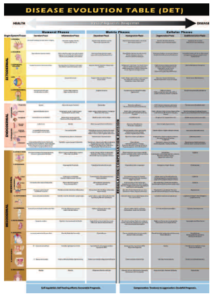
Dr. Reckeweg developed a six-phase disease table to map disease progression based on increasing toxicity levels within every organ system of the body. This framework helps practitioners determine the severity of the toxic burden and track the health of an organ system through these phases. Each body system— the skin, lungs, liver, kidneys, or cardiovascular system—can be assessed within this model to understand how increasing toxic bioaccumulation affects its normal functioning.9 The following is a description of each phase of the table using the skin as an example organ system:
Before you start using our services, you need to assess your health status!
It is better to do this with a doctor – We recommend!
But there are those who, with certain minor violations of their health, can assess their condition on their own!
The decision on what to do is up to you! The Disease Evolution Table (DET)

0 Comments